This article examines why Yellowtail Kingfish are not displayed in aquariums in Fukuoka, from the perspectives of swimming behavior, feeding structure, and environmental requirements. Maintaining their natural body shape and coloration in large tanks would require high-level replication of sardine-based feeding, high-speed water flow, and synchronized schooling behavior. Based on testimony from aquarium professionals and the author’s underwater observations, this article explores the reasoning behind the choice not to exhibit them in an unnatural state.
Why Aren’t Yellowtail Kingfish Displayed in Fukuoka Aquariums?
At Marine World Uminonakamichi, a major aquarium in Fukuoka, species such as rainbow runners, striped jack, and meagre swim in the main tank—but Yellowtail Kingfish are notably absent. Despite being a familiar fish in local food culture, why are they not exhibited? This article approaches the question not as a limitation of “cannot display,” but as a deliberate choice of “not displaying,” examined from a biological perspective.
The Aquarium Perspective: Three Essential Conditions
According to aquarium staff, maintaining the characteristic “form” of Yellowtail Kingfish requires meeting three conditions at an exceptionally high level:
- Feeding replication: Reproducing large-scale sardine predation, including frequency, density, and synchronized schooling behavior
- Water flow design: Creating sustained high-speed currents while maintaining low turbulence in a corridor-like flow
- Body condition maintenance: Balancing activity and feeding to prevent obesity, fading coloration, or physical decline
If these conditions are not met, the fish lose their natural body shape and coloration, resulting in a form that differs significantly from what is recognized as a “true” Yellowtail Kingfish. Displaying them in such a condition is avoided—this is the aquarium’s decision.
Understanding the Structure: Why Is It So Difficult?
- Swimming style: Kingfish = high-speed sustained swimmers / many pelagic fish = moderate, intermittent swimmers
- Feeding structure: Kingfish = coordinated 3D attacks on sardine schools / typical display fish = individual, planar feeding
- Energy balance: Kingfish = high activity × high feeding must coexist
- Tank design: Requires high-speed flow and a structure that does not disrupt schooling synchronization
In other words, displaying Yellowtail Kingfish is not simply a matter of placing fish in a tank, but whether it is possible to recreate the entire behavioral environment. Typical large tank designs struggle to reproduce feeding scale, speed, and synchronization simultaneously.
Alternative Expression: Deconstructing the Experience
Aquariums represent the dynamism of offshore ecosystems through alternative compositions. The movement of schools is expressed through sardines, while the power of apex predators is represented by sharks. Rather than replacing Yellowtail Kingfish, this approach deconstructs the elements and represents them faithfully.
Field Evidence: Observing Natural Predation Underwater
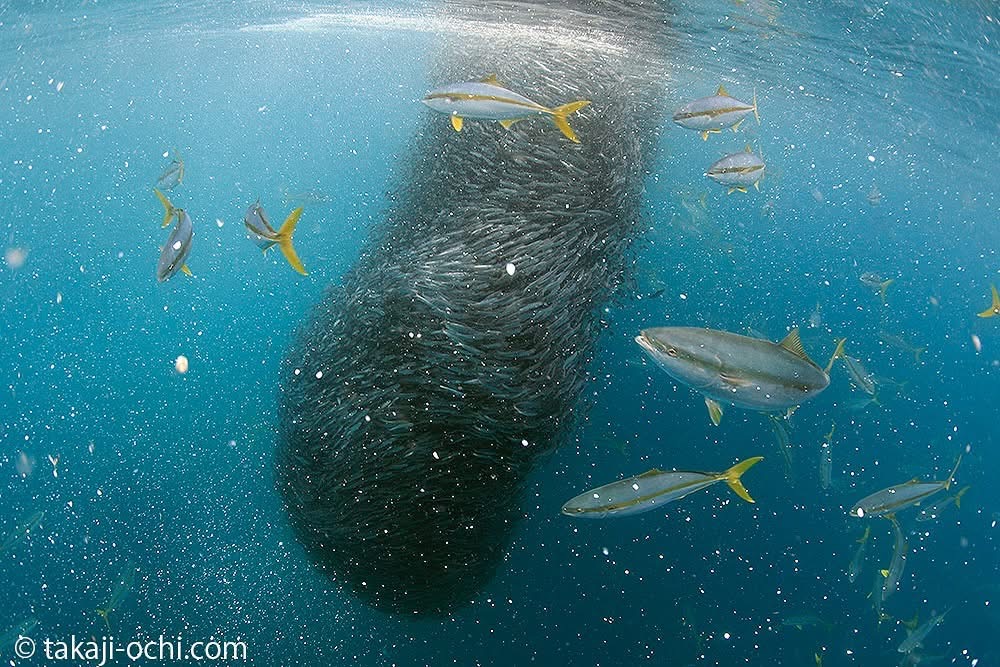
Underwater observation reveals moments where multiple Kingfish synchronize and charge into sardine schools, with scales scattering like snow. This is not simply a “fast fish,” but a behavioral system integrating schooling, current, and predation, which cannot be reproduced in fragments.
Conclusion: The Logic Behind Not Displaying
The question is not whether Yellowtail Kingfish can be kept in aquariums, but whether they can be displayed in their natural state. Under current large tank designs, maintaining body shape, coloration, and behavior simultaneously is extremely difficult. Therefore, choosing not to display them represents a rational decision based on respect for their ecology.
On the Distinction Between Fact and Interpretation
This article is based on testimony from aquarium professionals and the author’s underwater observations. It does not attempt to define biological classifications or technical limits of aquarium design. However, structuring the issue around swimming behavior, feeding structure, and environmental reproduction provides a conceptual model with explanatory and practical value.
Update History
- January 2026: First version published